ED-1-6
Asynchronous Reversible Logic Development With Ballistic Shift Registers and Fluxon Boosters
11:45-12:00 28/11/2023
*Waltraut Wustmann, Kevin D. Osborn
Laboratory for Physical Sciences at the University of Maryland, College Park, MD, United States.
Reversible digital logic can improve energy efficiency over irreversible logic. Reversible logic gates in superconducting circuits are currently made in the adiabatic type, where drive fields evolve the bit state. With Reversible Fluxon Logic (RFL) we are pursuing an alternative of the ballistic type, where key gates are solely powered by bit state inertia [1,2]. RFL represents the bit states by the two topological charges (flux polarities) of fluxons in a Long Josephson Junction (LJJ). Ballistic gates consist of at least two LJJs connected by a circuit interface and use a resonant conversion of a freely moving input fluxon to a new fluxon in the output LJJ. The polarity of the output fluxon may deterministically differ from the input bit, thus enabling bit switching. In simulations 1- and 2-bit RFL gates can restore 97% of the input fluxon energy in the output fluxons.
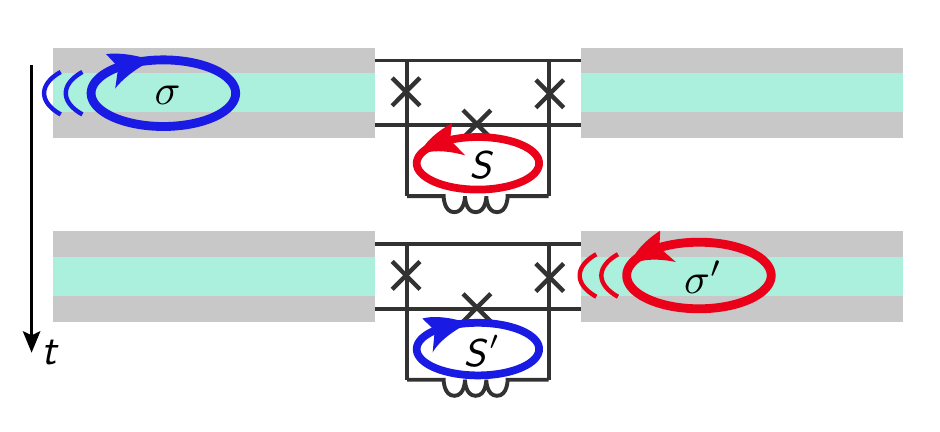
Since RFL gates operate without clock signals, previously developed 2-bit gates require synchronous input bits. In contrast, newly developed gates [3] lift this timing restriction as they can store an internal flux statein a storage cell and thus provide the means for the development of asynchronous gates. This is demonstrated with a ballistic shift register (BSR) whose operation consists of the elastic swapping of flux between the stored and the moving bit, again powered by the input bit alone. In addition to the base design of the BSR and its sequential extension on one bit line, we discuss a BSR which shares a storage cell between two bit lines. This gate allows a bit state to be set from one bit line and to be read out from another, and constitutes the first asynchronous reversible 2-input gate.
Since a fluxon bit slows slightly in each gate operation, it can ballistically execute only a finite number of sequential gates. We have developed a structure that can boost the energy of fluxons irrespective of their polarity, as required for RFL as a bipolar logic [4]. We discuss the design and operation of the booster that we consider to be scalable and study its performance in terms of boosted velocity, efficiency, and parameter margins.
[1] W. Wustmann and K.D. Osborn, Reversible fluxon logic: Topological particles allow ballistic gates along one-dimensional paths, Phys. Rev. B 101, 014516 (2020).
[2] K.D. Osborn and W. Wustmann, Reversible Fluxon Logic With Optimized CNOT Gate Components, IEEE Trans. Appl. Supercond. 31, no. 2, 1, (2021).
[3] K.D. Osborn and W. Wustmann, Asynchronous Reversible Computing Unveiled Using Ballistic Shift Registers, Phys. Rev. Applied 19, 054034 (2023).
[4] W. Wustmann and K.D. Osborn, Boosting Fluxons for Improved Digital Logic using an Aharonov-Casher Ring, arXiv:2305.0521.